Wednesday, October 28, 2015

The Gulflander Towns of Croydon and Normanton

The next section of road would take us through towns with historical links to the well known  Gulflander train.
Our first stop after leaving Georgetown was Croydon. A town that has done a great job at preserving their history and opening it up to share with visitors for free. 

First stop was the True Blue Tourist Information centre which had a mining display outside, a film on the local history and a wonderful mix of intetesting history display boards.

The town had a historical precinct with a series of restored buildings and two original street lamps with replicas to complete the scene. There was the Police Station and Residence, Court House, Town Hall, all built between 1887 and 1897.
The court house was complete with recorded trials with labeled board participants.

The Ten Head Stamper Mill used for gold was in a display of mining machinery outside the council chambers. While the old telephone exchange was part of a display in the old court house.

The town was the terminus for the Gulflander train and outside the restored train station, still in use, was this restored train.

A short drive out of town took us to a viewpoint from which we could look back over town. It also led to Lake Belmore where we stopped for lunch. We were unable to swim as the water was too low.

Our last stop on the drive back into town was the Croydon Chinese Temple Archaeological Dig precinct, a reminder of the part the Chinese played in the towns of the goldrush era. Below is a photo of a ... and the site of the Chinese temple. There were quite a few different sites with story/information boards.

Our stop for the night was at Black Bull Siding where the Gulflander train stops on Wednesdays and Thursdays for morning tea. There were information boards here for train passsengers to read, old water stands from the days of steam engines, and an old building once used for passengers to rest in. 
The sunset here on the open plains was beautiful.


The next town, and the origin for the Gulflander train journey was Normanton in the Gulf of Carpentaria. 
It is famous for the Gulflander Train ...


... And Kris, the largest saltwater crocodile ever captured in the world at 8.63m long. 

...... And the Purple Pub !

One of the early Gulflander trains on display outside the restored station. 

Interestingly enough in Normanton, after 15 months living/working in Queensland we finally discovered we could have a tourist library card which allows us to borrow in one town and return in another ! George is in seventh heaven !


By Lynne

Tuesday, October 27, 2015

Next Stop ... Cobbold Gorge !

Next stop .... Cobbold Gorge ! 

Cobbold Gorge is very different to others.  It is extremely narrow, close to only 2 metres wide in places, with spectacular 30 metre cliffs on either side. The water in the gorge is spring fed so the water level is constant, allowing boat access even in the dry season. In the gorge are Johnstone River fresh water crocodiles, native fish, a special variety of St Andrews Cross spiders, and ferns and grasses at the waterline. It is a part of Robin Hood Station.
Well I lie ... The next stop ... was actually Georgetown ! 

We had to decide whether it was worth driving the 90kms of dirt out to the Gorge, considering we didn't know whether I could access the boat or the walk to it. 
We also hadn't decided, if we went, whether to camp out in the tent and enjoy the resort there or do a day trip. We thought other travelers would be able to give us a good indication of what the tour involved. We could base the van in the park there while we drove out to Cobbold Gorge. 
Anyway we needed to stop for a few nights to allow us to catch up on ourselves and some more mundane things like the washing.

So after being told it wouldn't be worth it for me (the tour cost $82 per person)
... another lady who we'd met and got on really well with said she was going the next day and would let us know what she thought. She came back elated and said there was no way I was missing out on the gorge !  Even if I had to miss out on a large whack of the rest of the tour. 
So off we went early the next morning !

(I am not able to condense a lot of the photos into collages this time as they lost their effect when I tried. So, sorry to anyone that has data limits.)

The off road tour bus and boats which are less than 2 metres wide and a shallow draft, at times we were asked to keep oir fingers inside the rail as if the boat moved sideways even a little they may be cut off between boat and rock wall.

The first part of the tour was a walk down past the boats and along the river. At this point George climbed  with the guide and others to the top of the rim of the gorge. On their return they walked another 1km round trip to a pioneer grave, while I patiently waited in the heat.

This first one is at the beginning of the tour, near the pontoon.
Johnstone River Freshwater Crocodiles


It was the most amazing boat trip up the gorge, which the guide called a baby gorge in comparison to Lawn Hill. It was much younger and was a great example of how a much larger gorge began.

I was not able to do a large part of the walking tour which included a walk up a steep incline to a viewpoint overlooking the gorge, and a kilometre walk over uneven ground to a significant grave site. But I did enjoy the drive out, the gorge boat trip, and the gorgeous swimming pool at the resort which we swam in after the tour. We really enjoyed birdwatching from the edge of the pool. If I was going again I would camp a night out there.


 Some photos from Forsayth on our way home. 


By Lynne


Undarra - Our First Stop on the Savannah Way !


As we left the Atherton Tablelands we knew that the most exciting part of our touring was about to begin ! Two weeks touring across the Savannah Way to Karumba and then south on the Burke and Wills Development road. 
We also realised that we were traveling on the very end of the tourist season and it was beginning to get hot (mid to high 30's), many of the attractions were getting ready to close, there were fewer people on the roads, it was quite remote and the area like everywhere else is in drought. We had never really thought we would travel the Gulf area and here we were !

Our first stop was the Undarra Lava Tubes, one of the longest lava tube systems in the world. 190,000 years ago a massive eruption caused lava to flow more than 90 kms to the north and over 160 kms to the north-west. An estimated 23 cubic kms of lava, at a temperature of 1,200 degrees celcius flowed from the volcano, at a rate of about 100 cubic metres every second. Apparently at this rate it could fill Sydney Harbour in six days.

 We were there when Opera in the Outback was on so we attended the first night which was actually a Jazz - Broadway in the Bush night. What an exciting time ahead !
Our campsite. 

Before the Jazz night ...
We drove out to a part of the National Park in the morning, before it got too hot, where George could walk the rim of a volcanic Kalkani Crater and overlook the area from a viewpoint. While he did this I relaxed on a rug by the car and read. I had thought I might be able to try walking up but it proved too steep, and ... I was conserving my walking for the Lava Tube tour later in the day.

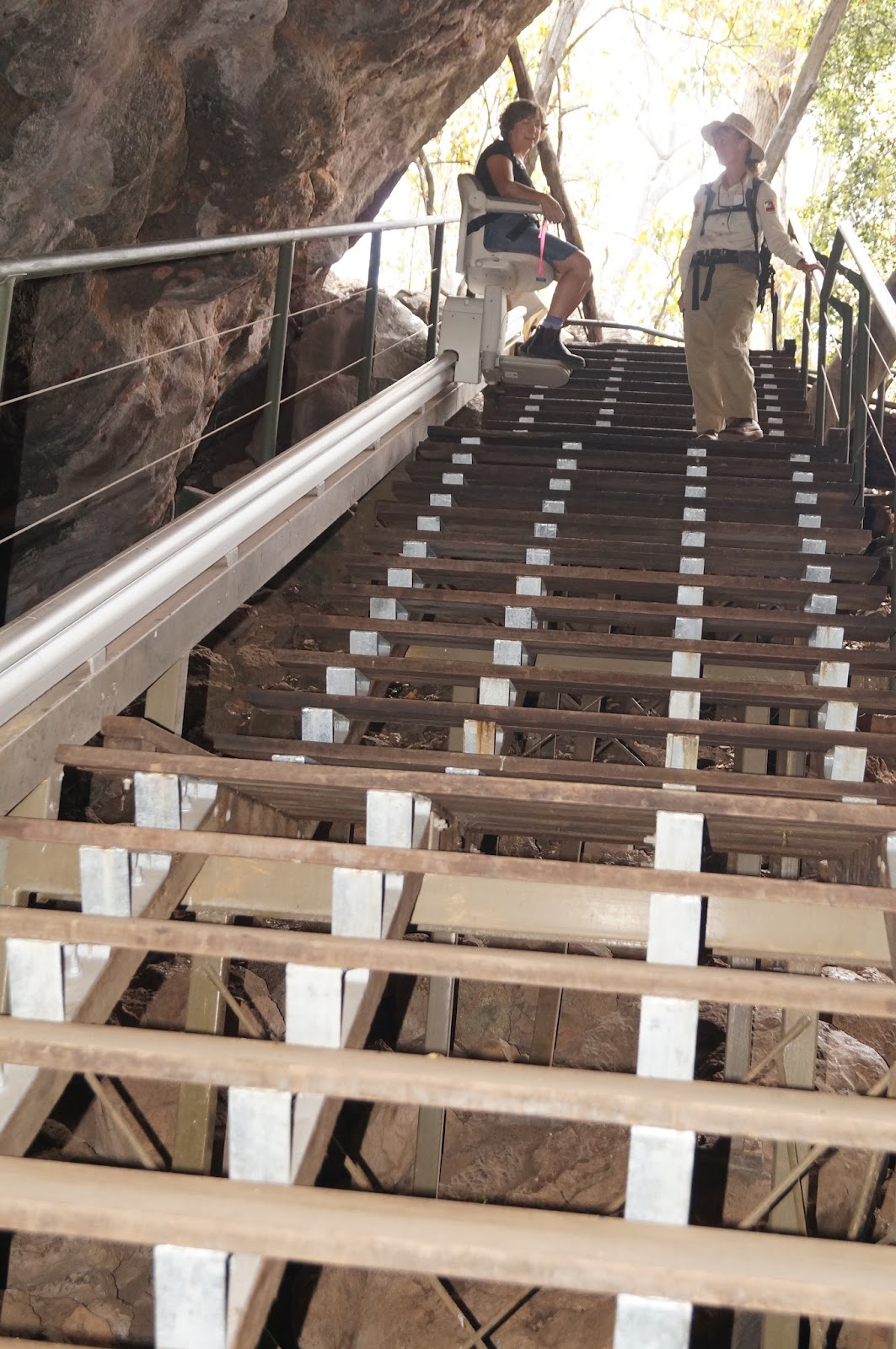
We did a special tour of the Lava Tubes in the afternoon for people with mobility problems. The tour for the general public was rated easy, but I saw they would run a mobility tour if requested and given 72hours notice. So I had rung ahead to enquire, inquisitive as to why they offered the alternate tour. The receptionist assured me the tour was easy, " it had lots of ramps and ONLY about 240 steps." Well just as well I asked ! ! 
 ... So we had a private tour of a different one, the Road Tour - Lava Tube, all on our own. This one was accessed using an inclinator .....

The bottom photo shows a micro-bat in the centre (if you enlarge photo hopefully you can see it).

In the evening we attended the opera in the Outback's first night, named Broadway in the Bush, it was a Jazz night. The band Far North, from Cairns, was brilliant. It was a quartet made up of drummer, keyboard, bass guitar and a double bass The young singer was Rhys Tolhurst who had contested Australia's Got Talent a few years ago. 

The setting, in an outdoor theatre in the bush was very different especially as the sun set. Many people were dressed in after five dresses and shirt and tie. We were told that it would get dressier over the next two nights as women would dress up in 'opera' gowns, and men in suits. Alcohol was available and a late dinner was also available after the shows.

Overall it was a wonderful experience and it would be great to be able to afford to go back for all three nights.

Some photos from the drive from Undarra to Georgetown.
We thought this was quite an unusual 'Beware of Cattle' sign.
We always have a laugh when we come across a red light in a remote area, especially after not seeing one for weeks at a time, and having seen no other car for ages.


By Lynne


Wednesday, October 21, 2015

Townsville to The Atherton Tablelands

Townsville to the Atherton Tablelands
On leaving Townsville we decided to have a couple of nights in a free camp and just relax and have some time to ourselves. We did not travel far but as the winds were terribly strong our first choice of staying on the coast at Balgal or Saunders Beaches was canned. We decided to camp a little more inland and drive out to look around the next day. We spent two nights at Rollingstone Free Camp while the footy finals were on. Interesting to say the least seeing that we were in Cowboy Territory.
Below are some photos from Balgal Beach north of Townsville. The bird is a black cockatoo.

We travelled through ....
... Cardwell where we stopped to investigate their small museum and display which was very well done. An excellent stop for young families as there was just the right amount of i formation mixed with a very visual display. There was also the pier and beach to walk along with a view out to Hinchinbrook Island.


.... Tully is a cane mill town and had some interesting sculptures in the main street in front of the mill. We also had to stop at the lights for a cane train heading into the mill. This had become a common sight for us in Queensland.

 We spent the night at the Garradunga Hotel and experienced our first green grassed lawn in a long time ! The chickens nearly took over our site ! It was a free camp that encouraged you to have a drink and a meal. This often works out dearer than a caravan park but the meals are usually great and large, as this one was.

Our last stretch of road in this section of our trip was to finally drive over the ranges and head inland. Typical, when we have to drive a stretch like this, it rained ! Our little ute towed our caravan slowly but surely up to the top to arrive in Malanda in the Atherton Tablelands on a cold and wet day. Our first sight of something different was the tea plantations on the side of the road. We stopped to buy a packet from a roadside stall which had an honesty box.


 At Malanda we settled into a lovely tree covered site backing onto the rainforest and the Malanda Falls. 

Determined as we were to see some of the falls in this area before heading to Undarra we headed out to see the Millaa Millaa, Zillie, Ellinja  and Malanda Falls in the rain in the afternoon.
Below the Millaa Millaa Falls
 The Zillie Falls

 And finally some other different sights ! The first a possum walk above the road and below a private helicopter in the yard of a dairy farm on the back road to Millaa Millaa Falls.

We have promised ourselves that we will return to the tableland area to spend a lot more time looking around !

By Lynne

Townsville - A Trip into the Hinterland.

A day was spent driving the windy, narrow steep road to Paluma and Paluma National Park. There was almost 200 bends in 18kms to finish 3000ft up at the town of Paluma. Here, to our surprise, not only did we gain views of the surrounding coastline but were treated to a private history talk about the surrounding area. The older gentleman was a fountain of knowledge. Turns out the only time the historical society hall is open is Tuesdays 9 till 1pm and that was the day we accidentally chose to go.


 On our return we stopped at Little Crystal Creek and Big Crystal Creeks in the park. Both natural swimming holes were totally different. 
Little Crystal Creek was a narrow creek which wound through a rocky area and under a bridge. The swimming hole was deceptively deep and locals were jumping in from a high rocky outbreak.

Big Crystal Creek was a wide open area accessed via a walk over a low hill. I was elated to find it had a fairly easy access for me. The water at both was crystal clear and perfect for swimming. Next time we will bring the van and stay in the park for a few days !


By Lynne